Monday, February 19, 2007

Top 5 Differential Diagnoses for Britney's Break

baldbrit.jpgDespite the appearance of physical health - at least, until she shaved her head - Britney is not well. To enlighten our writers and readers we decided to enlist the help of an Ivy League-trained clincal psychologist for this special edition of Celebrity Illness. Enjoy.

1. Substance Abuse Disorder - Addiction. That’s right, you guessed it. Like we said about so many young celebs in this article: if it smells like drugs, and looks like drugs.... it’s drugs! Coke, Meth, Crack, X, Alcohol…whatever. That’s my call.

2. Borderline Personality with Psychotic Features -
Altogether likely. Given the labile mood, strange and extreme behavior and chronic emptiness coupled and with pre-morbid narcissism, pattern of unstable relationships and shallow affect, BPD with psychotic features is definitely a contender for the diagnosis. It is almost a requirement for to be a Hollywood/performer type.

3. Psychotic Disorder NOS - Purely based on strange behavior and poor judgment, we don’t actually know if she has lost touch with reality (like hearing voices, seeing and/or smelling things, delusions). Unlikely since she is a bit old for a psychotic break..though still within the age range for women.

4. Postpartum Depression with Psychotic features -
Britney did just have a child within the past six months so we can’t totally remove it from the differential; it is unlikely because this diagnosis is usually diagnosed within the first 6 weeks postpartum…and it is kind of like she doesn’t have any children at all…so what is she depressed about? Hormones.

5. Bipolar Disorder - High on the differential because it is so hot and hip these days with the famous set. Britney’s impulsive behavior..partying (i.e. self-medicating), flying all over the country, checking in and out of rehab within a day, hyper -sexuality, shopping, irritability. True bipolar will generally see an approx 3 months manic period followed by deep depressive period for approx 9 months. So, we could be in the downward spiral anytime.

Friday, February 16, 2007

Notre Dame Head Coach Sues for Botched Bypass


Charlie Weis, head coach of the Notre Dame Fighting Irish and former Super Bowl winning offensive coordinator, testified yesterday in his lawsuit against two surgeons from prestigious Massachusetts General, who he claims were negligent following his gastric bypass surgery.

According to ESPN.com, the now svelte Weis said he spent more than a month in various hospitals, and following his release, had problems walking and could get around only with the help of a wheelchair or electric cart. His lawyer, Michael Mone, told the jury during opening statements Tuesday that Weis still suffers nerve damage in his legs.

How was his ambulation when he tipped the scales at 400 lbs? And his diabetes? And HTN? And obstructive sleep apnea, etc etc?

I am astonished that someone who signed a contract for $30-40 million over 10 years and is now healthy enough toWeis2.jpg walk the sidelines and handle a high-stress job like his, would sue doctors who are at the top of their field and clearly did not mean any harm.

Gastric bypass is inherently a complicated procedure and when a morbidly obese individually undergoes the surgery, this is explained to him or her. If the physicians made a erred during the surgery and corrected their error enabling him to successfully drop weight and return to coaching, what is he suing for?

Obviously, we are not privy to the details of the case but we do know he is coaching and that hey are Harvard surgeons who want the bet for their patients - especially high-profile ones like Weis.

Can the Fighting Irish fans sue Weis every time he makes a bad call or for their pitiful performance in Bowl games?

Doctors explained to Weis the risk of the surgery and he, in fact, waived a psychological assessment period so that he could be ready in time for football season. Now he is suing them?

Weis, as a head football coach, and a man who is familiar with risk-benefit analysis, whould recognize the complications inherent in such an invasive procedure - particularly in such an unhealthy individual. Big rewards can be gained form big risks - but like the deep pass and the double reverse, catastrophe can also occur. Weis is lucky that he is alive, healthier than before, and actively coaching a marquee program. And who does he have to thank for that? His team? His family?

No. His doctors.

Friday, February 02, 2007

Money for Nothing


An interesting article appeared in today’s New York Post. Turns out that the recently elected Governor Eliot Spitzer has caught on to the fact that several NY area hospitals were being paid for residents and fellows that were not actually training in the paid institution.

This is laughable to anyone who trains in a large city as hospitals are changing leadership and affiliations so frequently these days but medical education is rarely, if ever a real consideration in the transition.


Since hospitals are now run by administrators whose concern is to make money, they are much more concerned with the bottom line rather than medical education or the quality of academics at their hospital.

The Centers for Medicaid and Medicare Services (CMS) have been given the responsibility of paying hospitals for educating medical students and house staff based on the number of medical residents and doctors in training.
In New York, Spitzer and his staff discovered that for years, the state budget provided funding based on antiquated data. Through 2004, the state paid for resident-interns based on staff figures from 1981 and 1990. Does this surprise anybody?

"This [physician] education is critically important, but we're currently funding it in an excessive and irrational way that isn't directly correlated to the actual students being taught - thus costing the state exorbitant amounts of money in what amounts to general subsidies to teaching hospitals," Spitzer said.

"In fact, when we looked closer at this broken formula, we discovered that many of those dollars are going to pay for phantom residents and doctors who don't even exist. We will no longer pay for graduate medical residents who don't exist."
The problem is even more drastic then Spitzer knows. Hundreds of residency and fellowship vacancies exist in medical training each year. From esoteric heart failure fellowships to OB/GYN residency spots, ACGME-accredited spots go unfilled and there is no national database to feature them.

Instead, all of these medical training opportunities, which hospitals often get additional funding for, remain unfilled. Perhaps if training doctors were better informed of these existing training spots, they might be encouraged to apply for additional training or, training at all.

Often, medical training is the last consideration in the day-to-day running of a hospital which is ironic since so much of the care provided, particularly at large academic centers, is by those same residents, fellows and even medical students.

Thursday, February 01, 2007

Top 5 Most Annoying Hospital Noises


1. Telemetry – Beep, beep, beep, beep, Booonng! Booonng! Booonng! Annoyed yet? Multiply that times 400,000 and you have recreated the telemetry floor experience. Sitting next to alarming monitors and trying to write your notes is almost as torturous as resisting the urge to put your foot through one of them.

2. The Unanswered Phone – Will no one pick up that friggin phone? Nurses and ward clerks have developed some weird defense mechanism to a ringing phone. Not only do they lack the natural guilt that should go along with ignoring someone’s call but they almost relish the annoyance that others feel after the 9th, 10th and even 11th ring.

3. The Repeating Patient – I know, this one will not make the Top 5 Politically Correct list but at least we’re honest. Whether it is the aye-fibbers (“aye-aye-aye-aye”) or the Help-Me’s (no explanation needed), hearing a patient yell anything over and over and over again often makes you want to gauge your own eyes (or ears) out. If you’re lucky, they might throw in an inappropriate phrase occasionally to keep you on your toes.

4. Suction – Do we really need to elaborate on this one?

5. Pager – This website didn’t get its name for nothing. Go ahead and switch the beeper tone all you want, it won’t help. Even more annoying is when someone’s pager goes off in grand rounds and everyone in the room checks their pager, even if they are 100 yards away. Putting your pager on vibrate solves all of the above problems, except of course the annoyingness of being paged. We fear the day of downloadable pager tones.

Thursday, January 11, 2007

Rank and Guile


For many of you medical students out there, January 15th marks the birth of a new stage in your career. One that will lead you to hours and hours (and hours) of gratifying time spent in a specialty of your choice. It will signal the beginning of the end of kissing residents’ misshapely asses, scutting for good evaluations, and the education-comes-first mentality. Less than half a year from now, you will actually receive a paycheck, call yourself “Doctor” and you may even live in a different state - all contingent on that RANK LIST. The Rank is a curious creature and many medical students have made crucial mistakes that put them in specialties and/or states that were not for them. Thus, StopPagingMe.com has selflessly created a list of 5 rules for you to remember when constructing your ultimate Rank.

1. More is better. NRMP says: Applicants are advised to rank all of the programs deemed acceptable, i.e., programs where they would be happy to undertake residency training. Get it? If you could picture yourself at a place, put it on your list. And when you are hemming and hawing about whether you really would be happy at County, make sure the alternative you are comparing it with is no-place and it will make your decision a lot easier.


2. More is better. NRMP also says: “Unmatched applicants have shorter lists on the average than matched applicants. Short lists increase the likelihood of being unmatched.” Have we hammered this point home enough? Just in case we haven’t, think of how you’ll feel on Match Day when all of your friends are hugging and kissing and you’re worried about scrambling because you couldn’t picture yourself with all of those residents at County. Get over it and put everywhere you interview on your list!


3. Rank in order of your preference.
This is also straight form NRMP.org. The position of a program on your rank order list will not affect your position on the program's rank order list, and therefore will not affect the program's preference for matching with you as compared with any other applicants to the program. Translation: They don’t know where you put them so it cannot affect where they put you. That brings us to another interesting point: Tell every interviewer that they are your number one choice! Act happy to be there and convince them that this really is the place for you with some unique observation about wherever it is that you’re interviewing.


4. Don’t Believe the Hype. Choices should not be influenced by what an interviewer might say to you – positive or negative. One never knows who is interviewing after you and we don’t just mean that they might be smarter and have better USMLE scores. They might be the Chief’s nephew or the daughter of the program director’s secretary, or be high-rankingly hot. Interviewers are human and humans have feelings, wants, needs, likes, dislikes and issues. Thus, take all interviewers’ promises with a large grain of salt and refer to Rule #3.


5. Do your due diligence. First, go to www.NRMP.org and read how the match algorithm works. Now that you have included all of your possible programs and are stuck on the order of what you like best and least – it’s time to research your options. Find out who the program director and Chairman are; Google the hell out of your department; consider lifestyle aspects like where you’ll live (and for how much); do they publish; so they go on to fellowships; etc etc. You get it now – so get to it and best of luck Ranking your List.

Saturday, January 06, 2007

Appendiceal Surprise or Big Pack of Lies?

Appendiceal Surprise or Big Pack of Lies?

Our favorite VIP patient and frequent topic of this column, La Lohan, has been admitted again!

It’s really a shame that it happened during such a tender time for the 20-year-old party girl-turned-AA-member. She was just getting used to normal blood alcohol levels and then wham! – an acute abdomen.

The details of how and when she got admitted are hazy, as per usual, but piecing together various stories, the most likely scenario sounds like she saw a doctor sometime Wednesday who diagnosed her with a hot appendix and sent her to Century City Hospital in Los Angeles to have it snipped out, where she most likely stayed in one of their luxe VIP suites (seen in pic). Ooooh la Lohan.

We’re quite sure she’s a good judge of hospital VIP suites by now. Maybe she would consider doing a Top 5 Best Hospital VIP Suites for StopPagingMe.com?

Why is it that Lindsay keeps returning as an inpatient? Is it the young interns? The pain meds? The swing-arm TV?

Now, we would have given Blohan the benefit of the doubt had we not seen TMZ.com’s new video clip of her jaunting out of the hospital on post-op day #1 (POD#1).

There is no question that the party princess would have had her appy done by laparoscopic approach. This way, surgeons could easily hide the 1-2 cm scars below her ischial spines and inside her umbilicus (belly button). And yes, that is less painful and often results in quicker recovery – but 24 hours??? That is really pushing it from a pain tolerance and medical standpoint. It just seems silly that she would not give the trocar incision sites at least until the evening to heal up a little. Which brings up another interesting quandary: what type of pain meds did she get, being that sh is trying to clean up her act?

Typically, surgical patients, even those as young as 20, are observed for at least 24 hours to watch for any signs of infection (fever, chills, nausea, vomiting) and to make sure their gut is active again. That’s the best part. Gut activity is determined by the resumption of bowel peristalsis, or muscle contraction, forcing stool and air down the gut towards the rectum. Thus, docs determine if the gut is active by asking patients about flatus, aka ass-wind. I can just imagine the doctors asking LaLo if she beefed yet? Lucky bastards.

But if it was not her vestigial appendix what could it be? There are too many possibilities for what really could have happened, but here’s a short list:
- More “fatigue/exhaustion/anxiety/cocaine hangover
- Elective abortion – It’s a same-day procedure that is often well-tolerated and quite safe
- Some minor plastic surgical procedure
- UTI
- Gastroenteritis


Regardless of whether the Queen of Teen had an inflamed appendix or not, we would like to thank her for providing this column with so much fodder this past year. We wish Lohan the best of luck and health in the future and look forward to her returning several times in 2007.

Friday, January 05, 2007

Top 5 Reasons for the Short Coat

1. Target Practice – In the complicated hierarchy of academic medicine, attendings beat on residents, residents beat on interns, patients beat on interns, and nurses beat on interns (and anyone else that show signs of weakness). Since the interns are so grateful to have help, most do not transfer their abuse to the medical students who serve to a) scut, and b) deflect some of the nursial abuse. When nurses see a short coat, their eyes light up like it was free food day in the cafeteria and that lack of white fabric might as well be a bullseye or a sign that says: 'Yell at me for sitting in your chair.'

2. Limits Responsibility – Despite the lack of experience and knowledge connoted by the short coat, it brings with it a certain freedom, i.e. those who don the half-length jacket are not liable for any missed labs, failed blood draws or late discharges. Ah, the life of the blameless.


3. Still Works with the Chicks – When residents see the short coats, we secretly smirk at the awkward presentations, constant ass kissing and lack of hospital savvy that wear the mini-coat. We hearken back to times when a test at the end of the rotation was our greatest responsibility. They are the pledges of the medical hierarchy, the plankton of the medical food chain. But to non-medical people, they are future earners and the next potential Dr. 90210. The white coat equals doctor and to those who care about such things, that is the long and the short of it.


4. Bottoms Up – Myth has it that the long white coat was invented to cover up the expanding asses of residents and attendings unable to make it to the gym because of their hectic schedules. Still able to hit the treadmill regularly, med students can proudly display their backside, and help bring down their higher-ups just a notch. Fashion Sense – The sport coat is back, baby. Go to any club/lounge/bar in NYC and see for yourself. No longer reserved for the 35 and older crowd, the jacket and jeans look affords the wearer a unique sense of casual-formalness never seen before. Donning that short white coat with jeans and a loose tie could land you ahead of the fashion game. Or the victim of an ass kicking.

5. Fashion Sense – The sport coat is back, baby. Go to any club/lounge/bar in NYC and see for yourself. No longer reserved for the 35 and older crowd, the jacket and jeans look affords the wearer a unique sense of casual-formalness never seen before. Donning that short white coat with jeans and a loose tie could land you ahead of the fashion game. Or the victim of an ass kicking.

Wednesday, January 03, 2007

Why This Reality Show Might Save America


Say what you want about Dancing With the Stars or The Surreal Life. Go ahead and mock that Flavor Flav show and the inane lives of teenage rich kids as seen on MTV’s Laguna Beach. But don’t you dare include any of those shows in the same breath as The Biggest Loser, possibly the most important show to hit primetime in the past 50 years.


Reality programming has become TV’s version of crack. It’s easy to make and equally addictive. Put a bunch of camera hogs with personality disorders together in the same house and watch the entertainment ensue. Just imagine if you could use the dependency for good rather than evil - that’s right, healthy crack.


If you have not seen Loser, the basic premise is to get 14 morbidly obese people to lose as much weight as humanly possible in 100 days. They are divided into two teams and each team is given a personal trainer that works them like they have never been worked – and many of them really have never worked out. They are also taught important lessons about diet e.g. what is healthy and what is fat-inducing. They are taught how to order at a restaurant, how to prepare healthy family meals, how to count calories and so much more. Sure, there are blatant product placements and shameless ads for everything from low-fat turkey to exercise bikes but it’s all in good fat, er, fun. And the best part about all these life lessons that the losers get is that they are televised and even charted for the millions of obese watchers at home.


America is the fattest country in the world with more than ¼ of our population classified as obese. Our BMI’s are only matched by our insatiable hunger for TV, and reality TV in specific goes together with couch potatoes like special sauce on a Whopper. Who better to make you feel OK about yourself than 15 semi-retarded women literally fighting to marry a 5’3” ex-rapper with gold teeth and a giant clock around his neck?


The Biggest Loser is more effective than any institution or individual physician in combating the growing obesity epidemic. Not even the best of academia can affect as many lives over the course of a month as Loser does in one night. What doctor do you know talks to millions of households every week and shows demonstrable evidence that simple diet and exercise does indeed bare out results?


Week after week, the losers drop weight and improve physically and emotionally. There is a minimum of 10 crying scenes, 12-14 shots of massively sweaty tank tops and 6-8 mentions of how they are “doing it for their children”. As with any good reality show, there is bickering, badgering, complaining and just enough scheming to remind you that someone has to be sent home. But the proof is in the fat-free pudding for this bunch, as most often the person who lost the least weight is sent home to combat their eating issues alone.


Perhaps we like reality shows too much and are stretching to find the good in an otherwise crappy genre of TV. But if just one person at home learns that eating a short stack with two eggs on the side with bacon is not a typical breakfast then this show has succeeded in making people better. And isn’t that what we all want to do?


Check out this website to see some great before and after action http://www.biggestloserclub.com/.

Monday, January 01, 2007

Drug Rep: I'm Suing


A six-figure salary, free dinners, company car and a paid cell phone is not enough for some. Namely, Susan Schaefer LaRose, a former sales rep for drug giant Eli Lilly is the lead plaintiff in a class-action lawsuit seeking compensation for 18 years worth of unpaid overtime.


She was never promised overtime and it was clearly spelled out that because of the unique style of pharamaceutical sales tactics. overtime would not be compensated.

The lawsuits, filed in New York, California, New Jersey and Connecticut, are the latest in a series of mass tort claims seeking overtime pay from U.S. businesses in recent years.The pharmaceutical company lawsuits seek overtime wages dating back two to six years, under federal and state statutes of limitations. Other companies affected are Boehringer Ingelheim Pharmaceuticals Inc., AstraZeneca PLC, Pfizer Inc., Johnson & Johnson, Amgen Inc., Hoffmann-La Roche Inc., GlaxoSmithKline PLC and Bayer AG.Schaefer LaRose said her 45-hour work weeks began lengthening as cell phones and e-mail became more prevalent."Those things were supposed to simplify our lives. They didn't," Schaefer LaRose said.

Anthony DeMeis, a co-founder of the Pharmaceutical Representative Society of New York, said it was unfortunate that some people are looking for ways to get more money from their employers. He said he doesn't know of many other jobs that offer college grads $60,000 to $80,000 a year with a free car and free cell phone.

"Everyone I know who does their job well works 60 or more hours a week," DeMeis said. "The harder you work, the more work you make for yourself. I think they're getting paid for overtime, through the bonuses they're getting."

Wow, we're not sure what to say about this. How many times did LaRose use her cell phone for personal calls? How about her corporate card and her generous bonuses? At a time when drug companies are criticized by the public the pharmaceuticalreps are being shunned by the docs, this disgruntled employee has a lot of moxie to think a jury will have a sympathetic ear to her pseudo-plight. Wining and dining a bunch of doctors is not like working in the mines or even toiling over hours of code (a similar lawsuit was won by IBM IT staff). It is known to be a social occupation in which employees tend to work hard and play hard. It is no secret that these reps are as much social event planners as they are purveyors of medication knowledge. The qualifications for the job are not steep and the most social of the bunch inevitably surpass their colleagues who would rather spend time at home. If this was a problem for her, why did she continue her job for 18 years? Regardless of the merit of the case, it is nice to be writing about a drug company being sued, rather than doctor.

Sunday, December 31, 2006

Leave Us A-Clone


After months of debate and review, the US Food and Drug Administration (FDA) will soon rule that food from cloned animals is as safe to eat as food from conventionally raised ones.Sweet cloned meat! The food police have confidently stated that eating meat and milk from cloned adult cattle, pigs, goats and their genetically identical offspring is as safe as eating those products from animals whose DNA is slightly different.


Sheep were left out of the FDA report due to lack of evidence and when reached for comment, Dolly the Sheep, was quoted as saying "baaaaa." She's a sheep, dudes.


The implications of allowing cloned meat are enormous - we just cannot figure out what they are. Give us a break, we're doctors, not genetic engineers. If it means that the price of Kobe beef drops, then we're all for it. Maybe next they can clone mutant chickens that produce larger appendages so that eating Buffalo Wings isn't such a difficult process.


Being "scientists", I suppose we are a bit obtuse about why people would object to eating cloned meat? The cells are disrupted during the cooking process anyway and there is no danger in eating twin cows so why would cloned cows be any different? Are people concerned that this is the start of a slipper slope and that next thing we'll be cloning nannies and soldiers? Someone please explain to us the bad part of eating cloned food or the cloning process because we feel like arguing with you.

The Pathophysiology of Saddam's Death

Early Saturday morning (New York time) , we awoke to news of Saddam's hanging. Whether it was the just and correct punishment for the ex-leader of Iraq is not the purview of StopPagingMe.com, i.e. we don't "go there". However, we do go where few others would, which is the actual mechanism of action in a death by judicial hanging. A typical hanging involves being suspended by the neck and can be classified as either "complete" or "incomplete."

When the whole body is hung off the ground and does not touch the floor or platform at the end of the drop, the hanging is said to be complete. Incomplete hangings imply that some part of the body is touching the ground.

Simple asphyxiation is very rarely the cause of death in most hanging injuries. Cervical spinal disruption secondary to the forces involved in the hanging are almost uniformly fatal. Significant cervical spine and associated injury to the spinal cord occurs in hangings that involve a fall from a distance greater than the body height.If that does not do the job than near-complete compression of both areterial and venous systems will induce a profound parasympathetic response and cerebral anoxia.

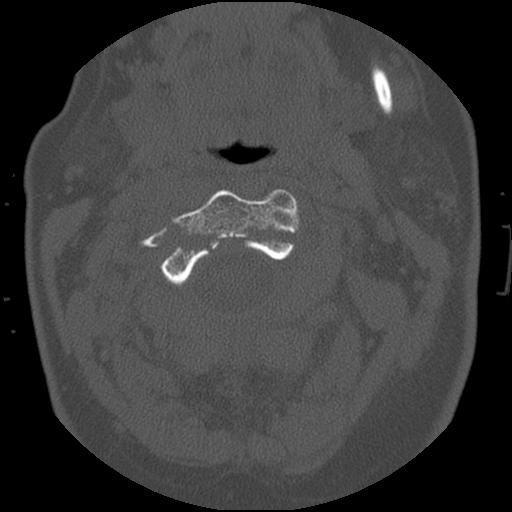
In a judicial hanging, as was prescribed for Saddam, the drop is at least as long as the height of the victim and the hanging is complete. In such cases, the mechanism of death is effectively decapitation, with separation of the head from the neck and torso, fracture of the upper cervical spine (typically traumatic spondylolysis of C2 in the classic hangman fracture), and transection of the spinal cord.

In judicial hangings, the head hyperextends as the noose stops the victim. Classically, the result is bilateral fracture through the pedicles of C2 (see pic at left); the body of C2 is displaced anterior to the vertebral body of C3.

These hangman fractures are seen best on the lateral radiograph of the cervical spine (see pic above). StopPagingMe.com rarely delves into the political forum and will abstain in this instance as well but we are surprised by the casual stance the media has taken to airing such graphic pictiures.

It may seem hypocritical of us to cast aspersions when we have just dissected the mechanics of his death but we are read by like 4 residents and a couple of medical students - not seen by millions.